
Fixed Weights vs. Dynamic Weights
Questions
Questions:
- Fixed Weight Indices refer to having a predetermined weight for an individual asset level for each calendar year, whereas Dynamic Weight Indices have weights that vary with the current strategy conditions.
- Can we generate a Fixed Weight index with similar performance to a Dynamic Weight index?
Approach:
- AiLA indices are typically Dynamic Weight indices.
- Already existing Long Only and Long-Short AiLA indices are considered and converted to Fixed Weight indices by averaging the individual asset allocations over in-sample period for each calendar day of the year.
- The obtained fixed weights are then applied on the out-of-sample period and compared with the respective Dynamic Weight indices.
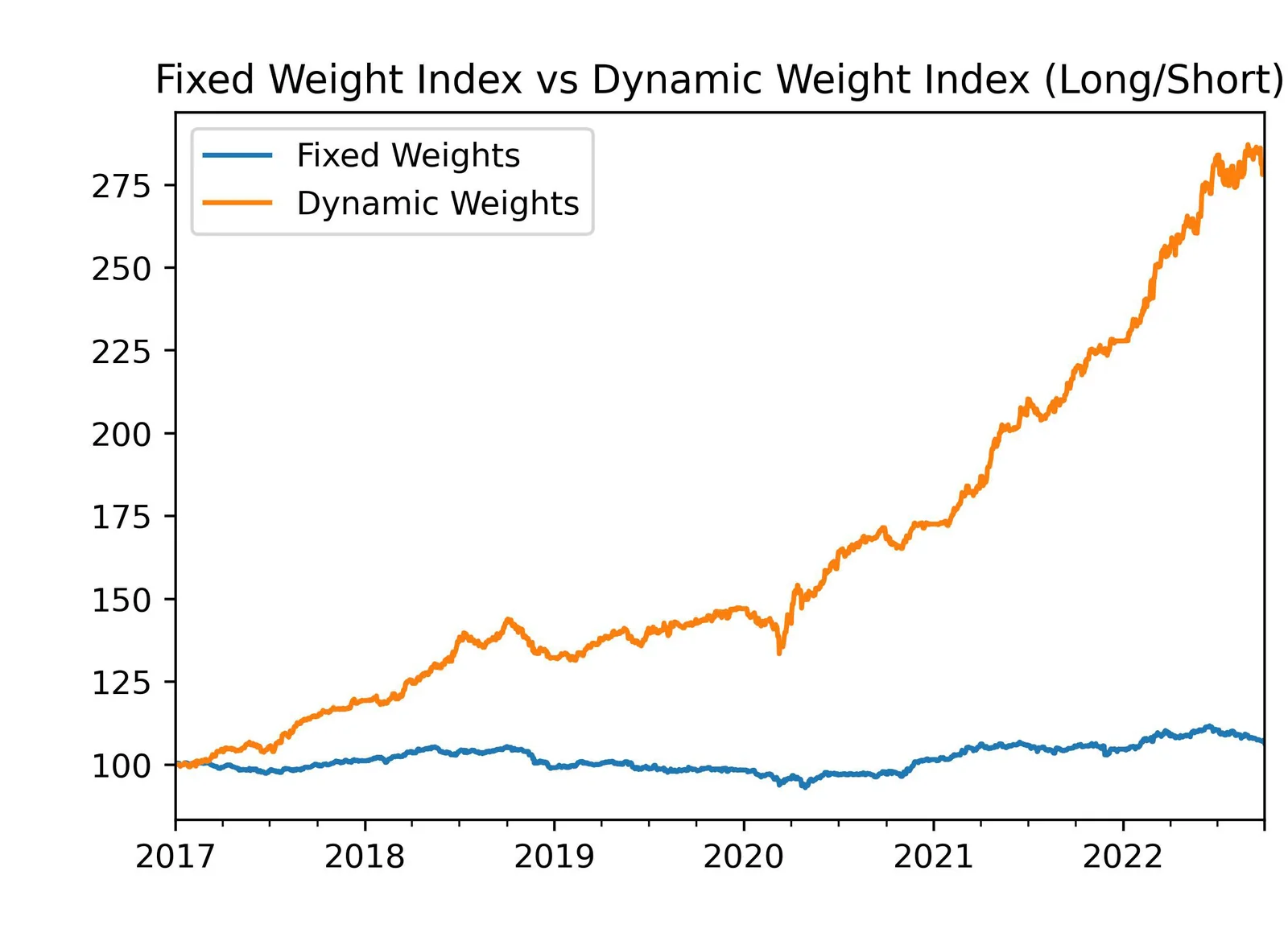
Figure 1
Comparison between the Fixed vs Dynamic Weight Index based on a Long-Short Index
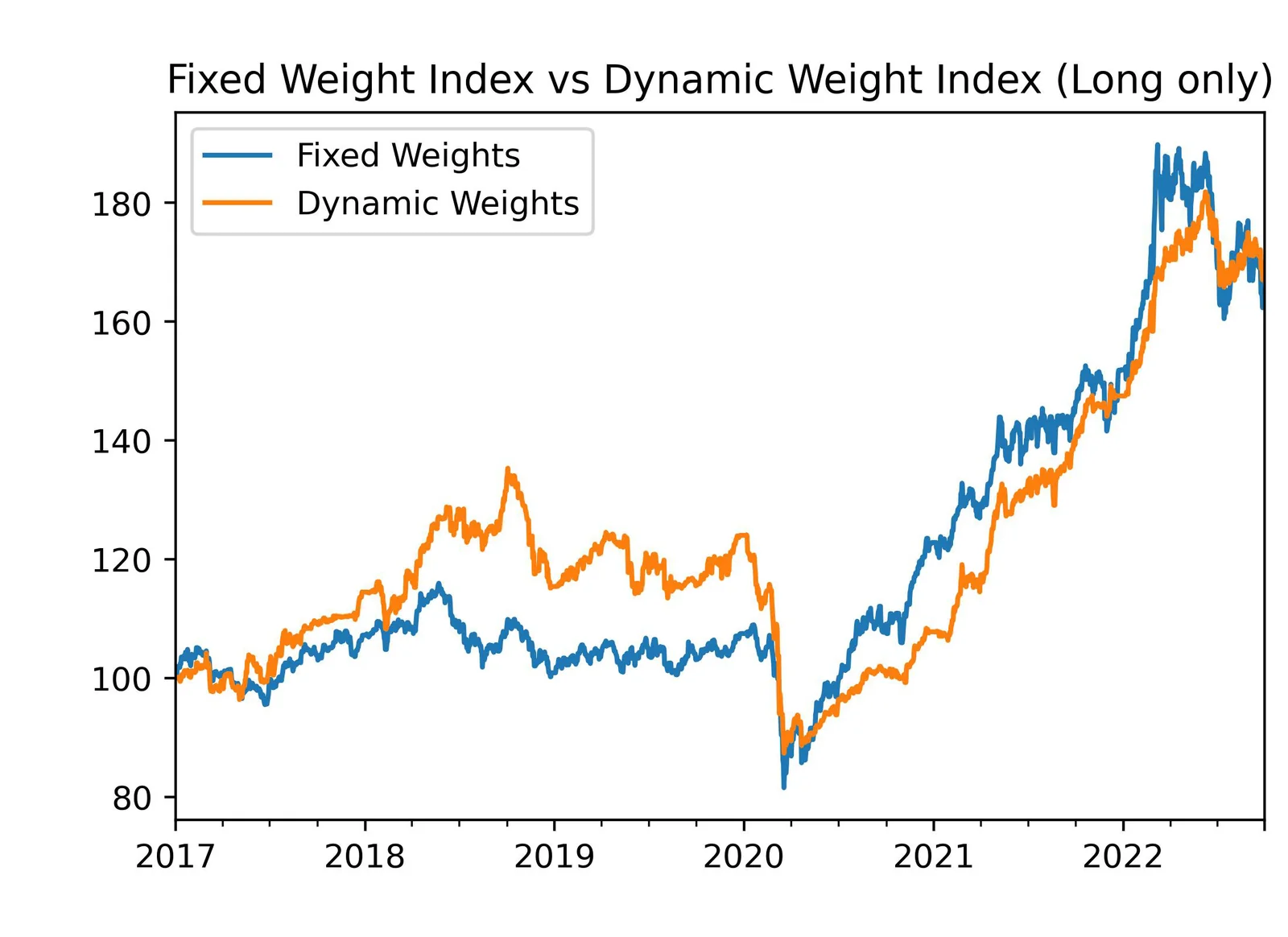
Figure 2
Comparison between the Fixed vs Dynamic Weight Index based on a Long-Only Index
Generating Fixed Weights
- Two already existing Long-Only and Long-Short AiLA indices are considered for this purpose.
- The fixed weights are calculated over the in-sample period of 2011 to 2016.
- The signed weights for all the individual assets that form the selected AiLA index are obtained, where the weight represent the percentage of total capital allocated and the sign corresponds to being long or short.
- For each calendar day of the year and for each asset, the signed weights are averaged which would result in a matrix of weights for all the assets for each calendar day.
- The signed weights of the individual assets are further scaled to make sure the absolute value of the sum of the averaged signed weights for any calendar day is always less than or equal to 100%.
- The resulting weights are then applied over the out-of-sample period based on the asset and the calendar day of the year.
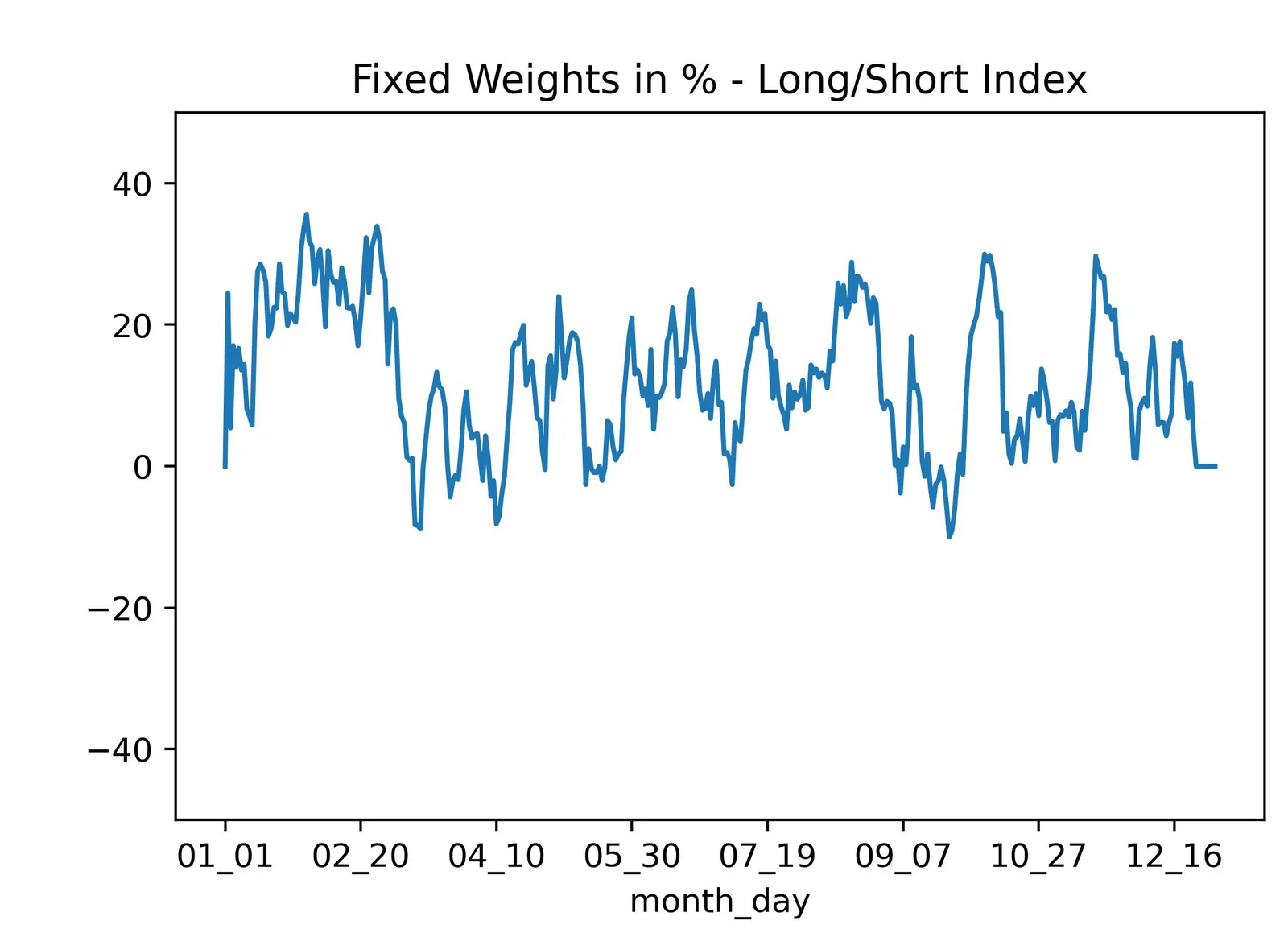
Figure 3
Absolute value of the sum of the total allocations on each calendar day of the year for Long-Short Index
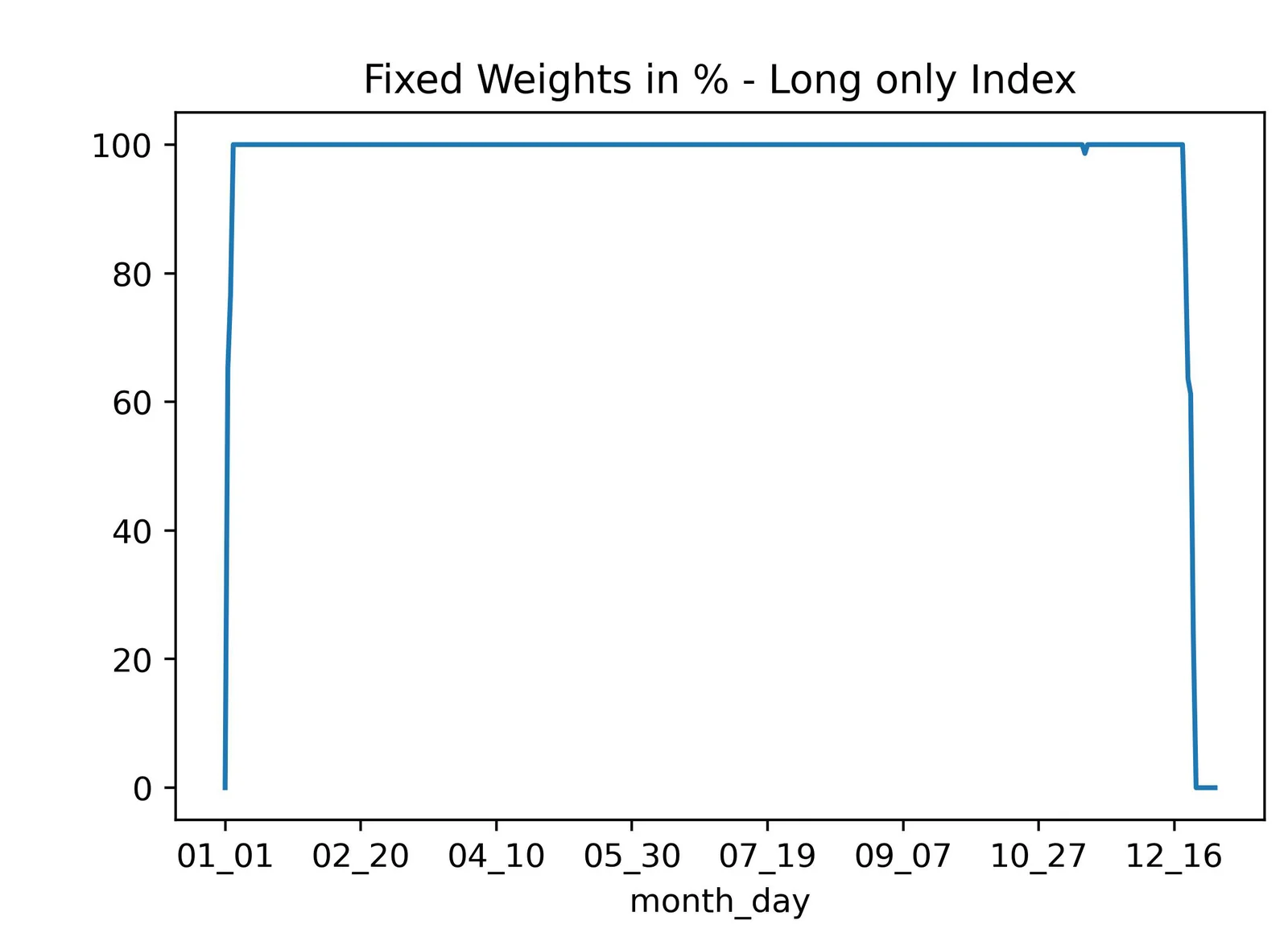
Figure 4
Absolute value of the sum of the total allocations on each calendar day of the year for Long-Only Index
Fixed Weights vs. Dynamic Weights
- The obtained fixed weights are applied over the out-of-sample period over Jan 2017 – Sep 2022.
- The daily index returns are obtained by calculating the weighted average of the returns of the individual assets with the weights being the fixed weights for that calendar day.
- From Fig 1 and Fig 5 of the Long Short index, Dynamic Weights version performs significantly better than the Fixed Weights version and the Standard Commodities Indices.
𝑆𝑅 Fixed Weights = 0.270
𝑆𝑅 Dynamic Weights = 2.355
𝑆𝑅 Standard Index - 1 = 0.318
𝑆𝑅 Standard Index - 2 = 0.355
- From Fig 2 and Fig 6 of the Long-only index, Dynamic Weights version performs better than the Fixed Weights version before the COVID and performs similar during the post-COVID.
𝑆𝑅 Fixed Weights = 0.695
𝑆𝑅 Dynamic Weights = 0.811
𝑆𝑅 Standard Index - 1 = 0.318
𝑆𝑅 Standard Index - 2 = 0.355
- In terms of the performance metrics, the Dynamic Weights version is better than the Fixed Weights version in both Long-only and Long-Short cases and the Standard commodities Indices as well.
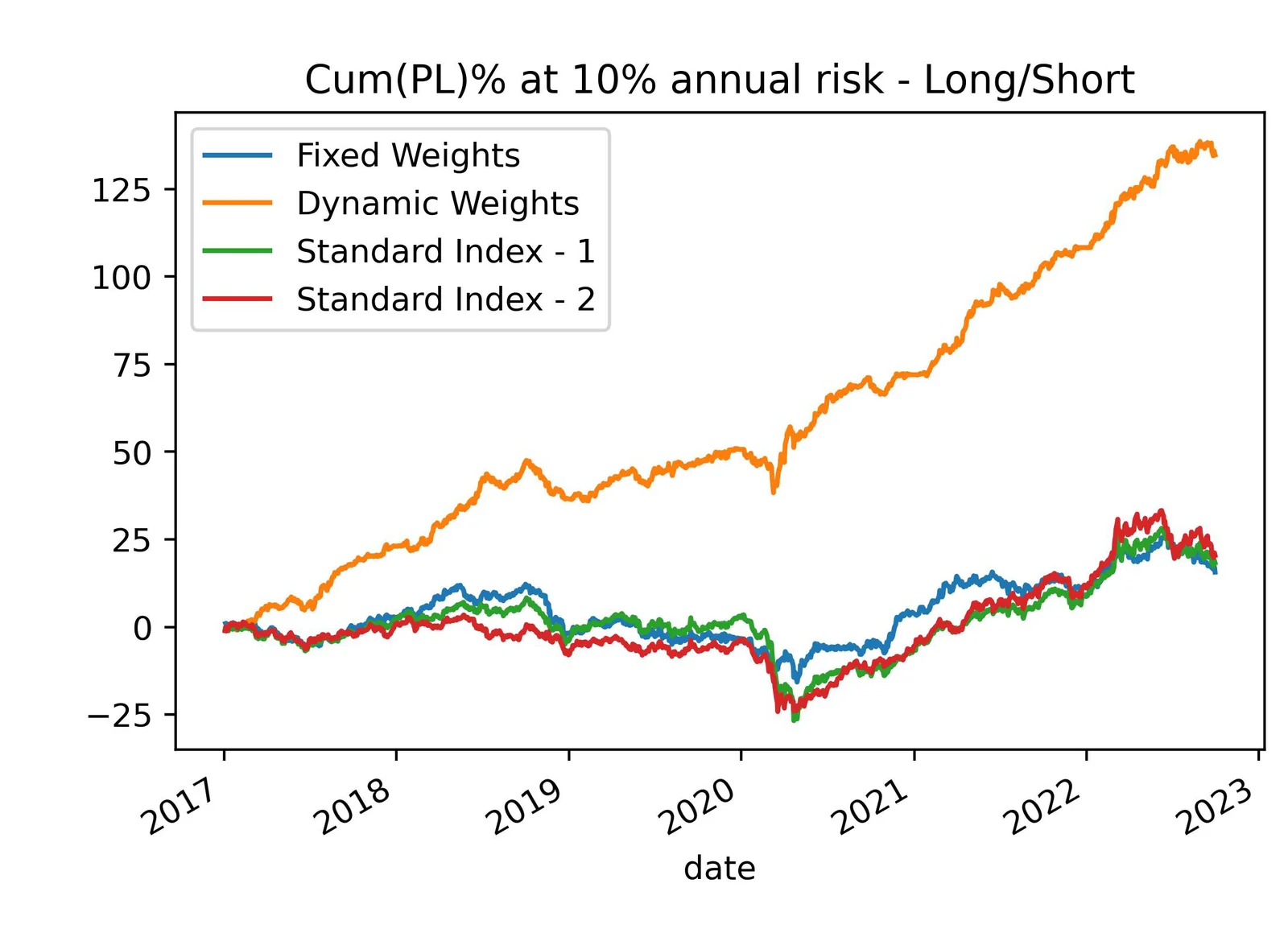
Figure 5
Risk adjusted performances of fixed weights and dynamic weights versions for a Long-Short index along with standard indices
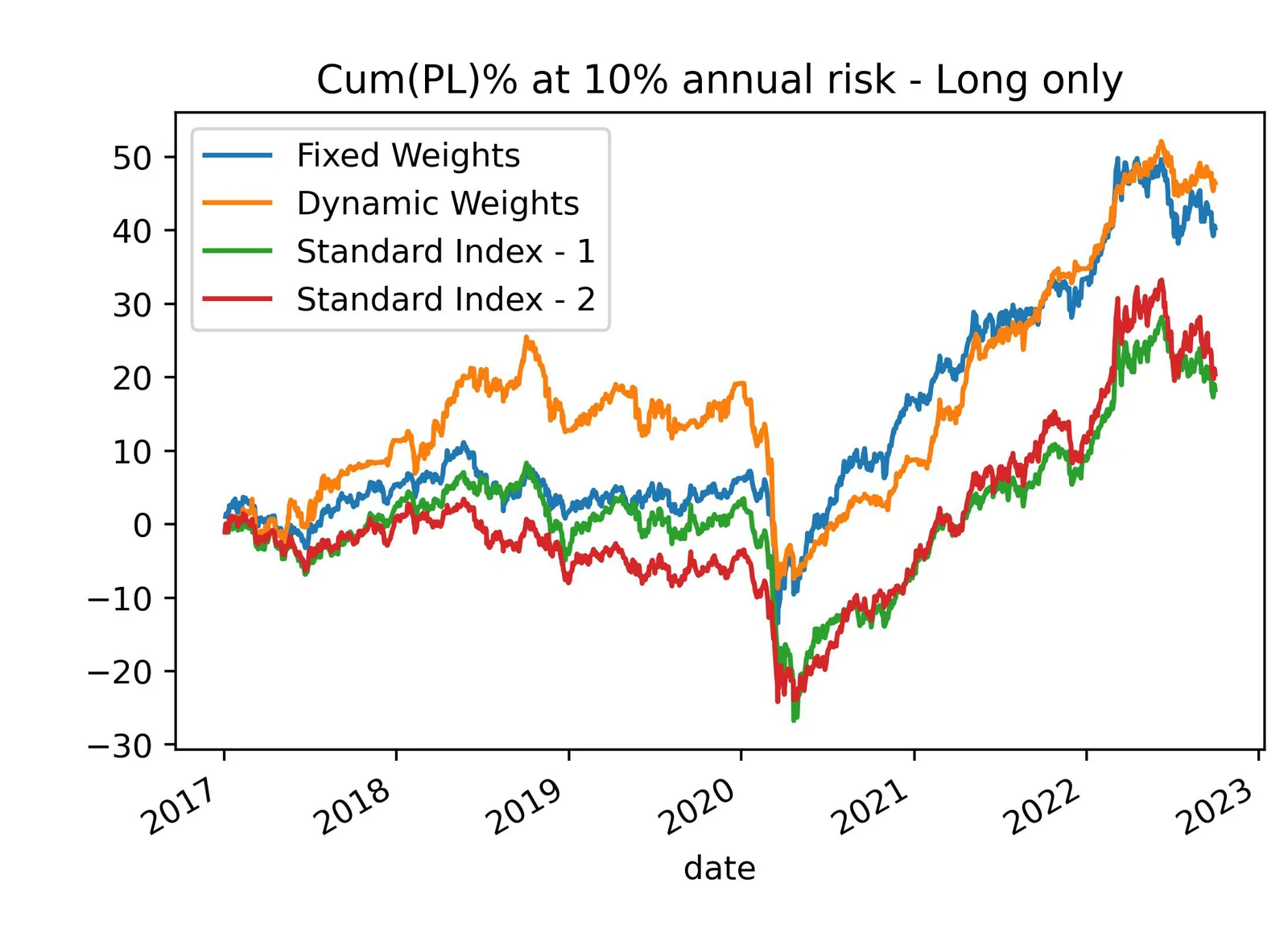
Figure 6
Risk adjusted performances of fixed weights and dynamic weights versions for a Long-Only index along with standard indices
Conclusions
- The objective of this research is to understand the feasibility of generating weights for each calendar day of the year which can be applied every year and match the performance of a dynamic weight index.
- Two existing Long-only and Long-Short dynamic weight AiLA indices are considered for the analysis and their fixed weights versions are obtained by averaging the signed weights over the in-sample period (2011-2016) for each calendar day of the year.
- The obtained fixed weights are applied over out-of-sample period (2017-present) and for both the long-only and long-short indices, the dynamic weights version outperforms the fixed weights version.
- For the long-only index, the dynamic weights version performs slightly better before the COVID, however, both move together during the sharp fall during the COVID and during the bull run post COVID which is very similar to the performance of the standard commodities indices during these periods.
- For the long-short index, the dynamic weights version significantly outperforms as it can make appropriate decisions based on the existing market regimes and macro structures to capitalize on every possible market condition, where as, the fixed weights version is forced to act based on the average market condition from the past.
- Both the Long-only and Long-Short dynamic weight Indices perform better than the standard commodities indices as well.
- In conclusion, the dynamic weights appears as the better choice to build an all-weather alpha index.