
Exit Timing and Performance Impact
Exit Strategy
Rebalancing and Risk Management:
- The strategies are rebalanced at close, e.g. typically using TAS or MOC orders.
- Asset level risk management framework will exit an active allocation in the case of,
- The allocation reach a pre-defined performance target (TR).
- The allocation hit a pre-defined performance stoploss (SL).
- An opposing allocation opportunity arises (OA).
- The allocation reaches its pre-defined holding period (HP).
- For an exit criteria that is met at day T, the exit instruction will typically be executed at close on the day T+1.
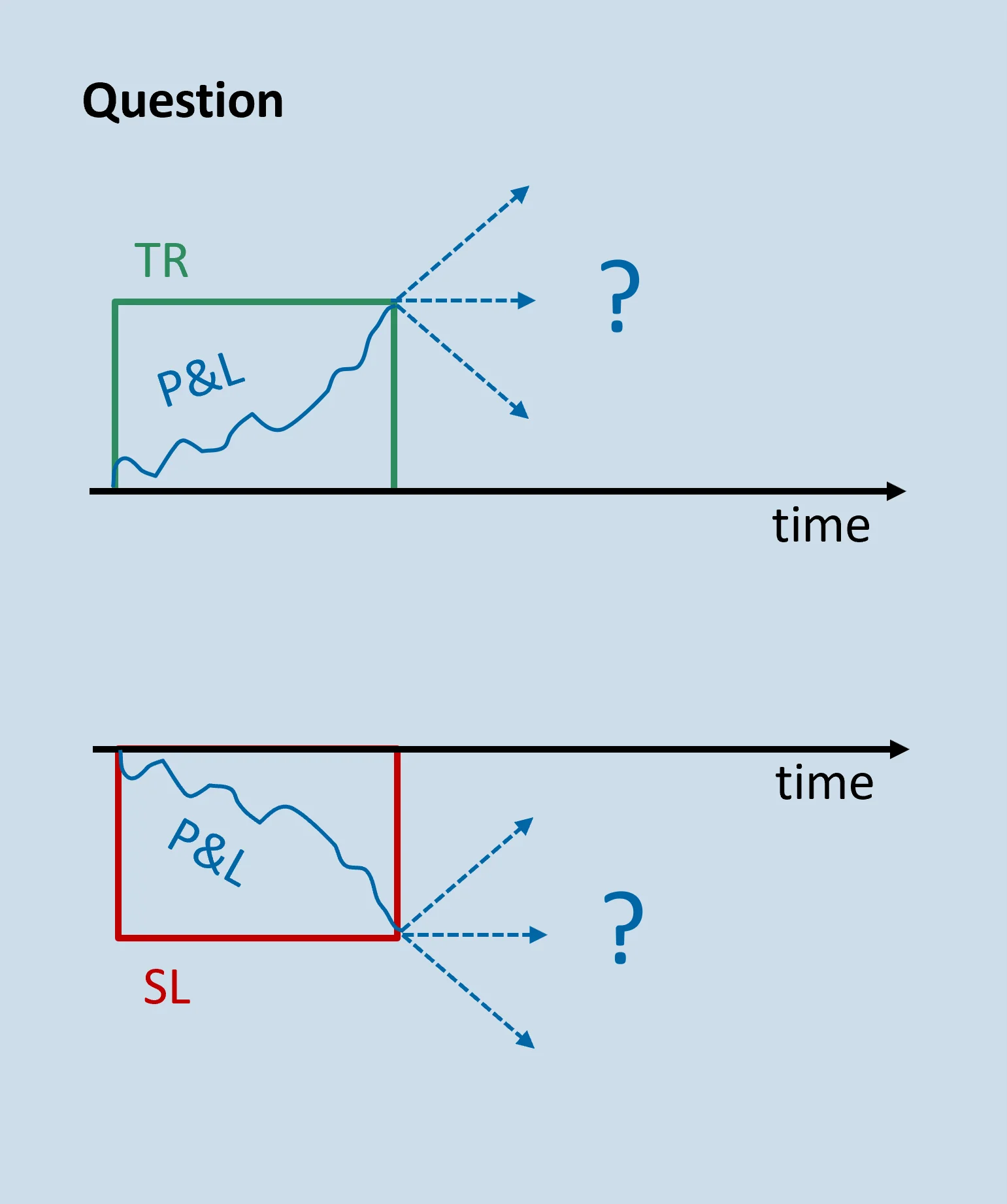
Question:
- What is the performance impact from the delay between meeting the exit criteria and its execution?
- The question is addressed in the context of exit initiated by hitting a stoploss or target, since they are triggered by profits and losses.
Stoploss Impact
For all portfolio asset allocations:
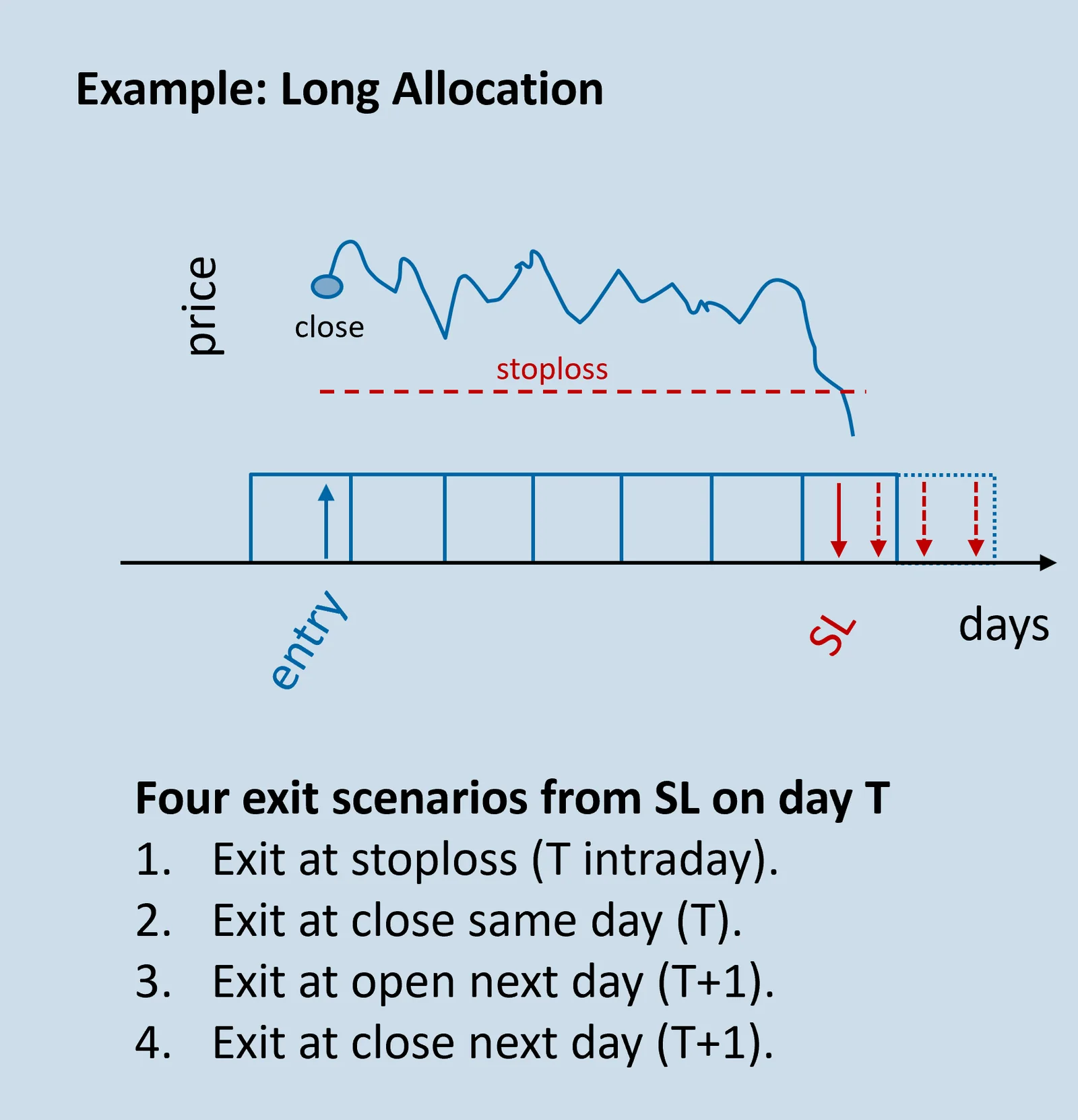
- Identify allocations exceeding SL threshold before exit, i.e. without meeting other exit criteria before SL.
- Calculate allocation return based on low (high) price for long (short) allocations with respect to close at entry, to be compared with SL threshold.
- For the SL allocations, record additional return due to later exit time.
Three late exit return differences:
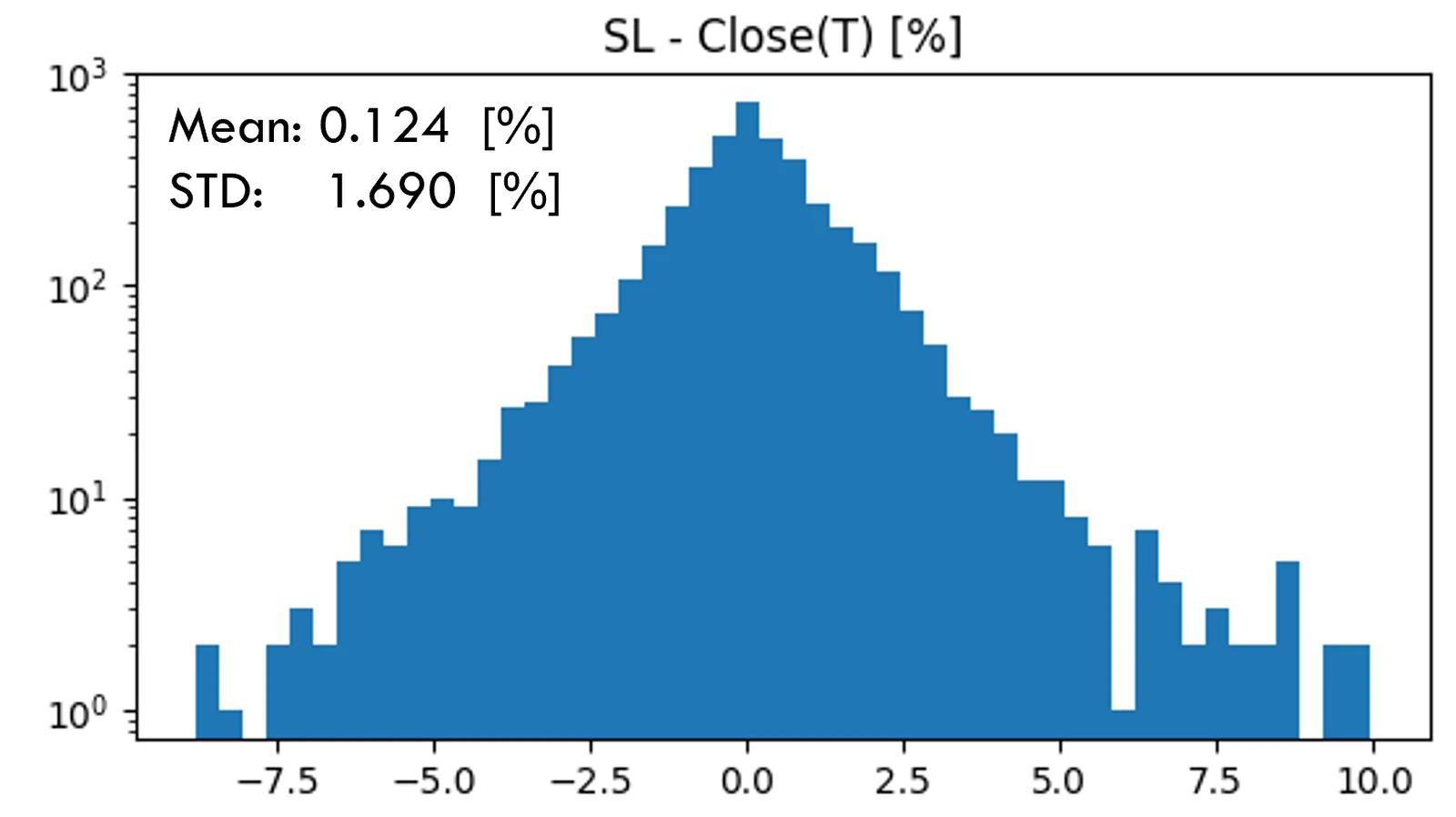
- SL – Close(T): ∆return from SL and close on day T.
- SL – Open(T+1): ∆return from SL and open on day T+1.
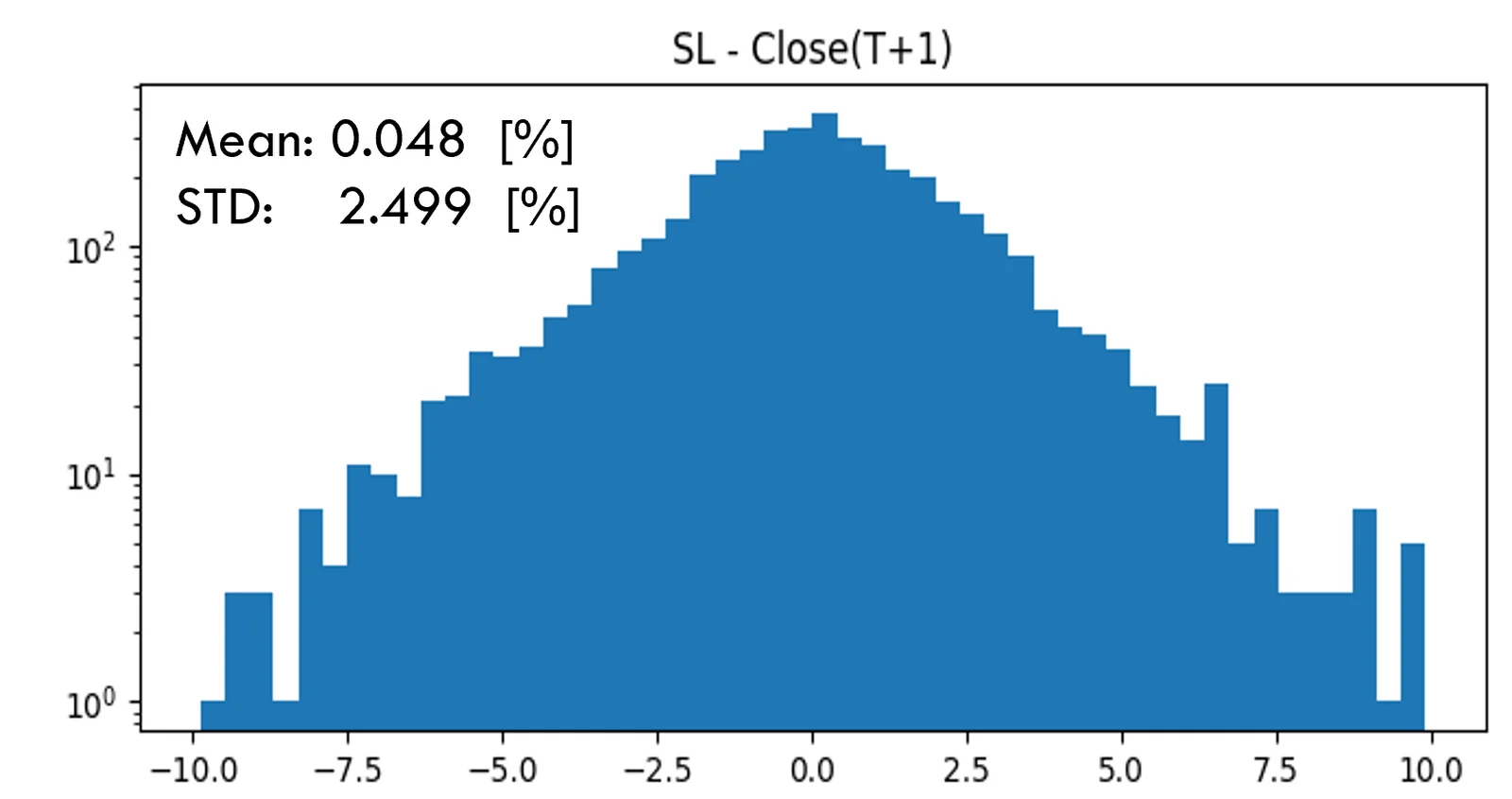
- SL – Close(T+1): ∆return from SL and close on day T+1.
A positive return difference therefore corresponds to SL loose less than if exiting later.
Stoploss Impact
Results Observed:
- Indicate slightly positive mean.
- Mean decrease with later exit time, e.g. close(T) vs close(T+1), could indicate a tendency of reversion the day after.
- Practically small effect, e.g. “interpretation”
- SL – Close(T): "6 days +1.7% vs 7 days -1.7% "
- SL – Open(T+1): " 15 days +1.8% vs 16 days -1.8% "
- SL – Close(T+1): " 25 days +2.5% vs 26 days -2.5% "
In average, results suggest that exit at close on T+1 is as good or slightly beneficial with respect to earlier exit options, e.g. due to reversion tendency.
| Stoploss | Mean | Std Error |
|---|---|---|
| SL - Close(T) | 0.1236 | 0.0259 |
| SL - Open(T+1) | 0.0571 | 0.0280 |
| SL - Close(T+1) | 0.0478 | 0.0384 |
Target Impact
Results Observed:
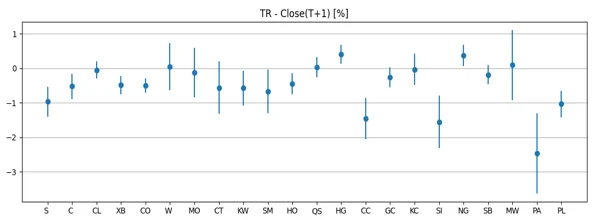
- Same analysis, however, for exit due to hitting target threshold show opposite tendency.
- Indicate slight negative mean of distributions.
- Mean decrease with later exit time, e.g. close(T) vs close(T+1), could indicate a momentum tendency the day after.
- Breakdown per commodity indicate that a majority of the commodities contribute with a negative mean.
- Target thresholds typically larger than those for stoploss, resulting in lower (larger) analysis statistics (errors).
- Negative return difference corresponds to TR profit less than if exiting later.
In average, results suggest that exit at close on T+1 is as good or slightly beneficial with respect to earlier exit options, e.g. due to momentum tendency.
| Stoploss | Mean | Std Error |
|---|---|---|
| SL - Close(T) | 0.1236 | 0.0259 |
| SL - Open(T+1) | 0.0571 | 0.0280 |
| SL - Close(T+1) | 0.0478 | 0.0384 |
| Target | Mean | Std Error |
|---|---|---|
| TR - Close(T) | -0.0641 | 0.0580 |
| TR - Open(T+1) | -0.1394 | 0.0649 |
| TR - Close(T+1) | -0.2067 | 0.0771 |
Portfolio Comparison
Results Observed:
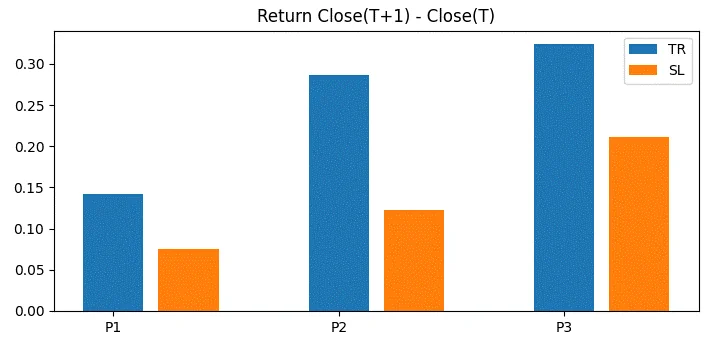
- Result compared between three different portfolios, i.e. P1 to P3.
- Two different commodity portfolios and one equity index portfolio.
- Comparing returns from Close(T) to Close(T+1) show a consistent pattern between portfolios.
- All in support of results observed above.
In average, results suggest that exit at close on T+1 is as good or slightly beneficial with respect to earlier exit options, both when exit triggered by a stoploss as well as a target.
Conclusions
- The AiLA strategies typically are designed for a daily rebalancing where the execution takes place at close on the day T+1, with respect to the day (T) when the instruction is generated.
- Asset allocations operates within a risk management framework with pre-defined stoploss and target thresholds, at which an active allocation will exit.
- This short analysis try to address the question:
What is the performance impact from the delay between meeting the exit criteria and its execution? - The results suggest that:
In average, results suggest that exit at close on T+1 is as good or slightly beneficial with respect to earlier exit options, both when exit triggered by a stoploss as well as a target.