
Diversification Benefit
Questions
Questions:
- How much improvement can be expected from diversification for an AiLA index?
- Many commodity markets have low correlation so expect significant potential for diversification.
- However, same market contracts and certain sectors are highly correlated, implying limited diversification.
Approach:
- Investigate general diversification potential using a representable set of AiLA asset signals.
- Generate random index compositions for a given number (N) of portfolio assets.
- Compare average performance as function of N, including different conditions for cross checks.
Diversification Potential
- Investigated by generating random index compositions for varying number of assets.
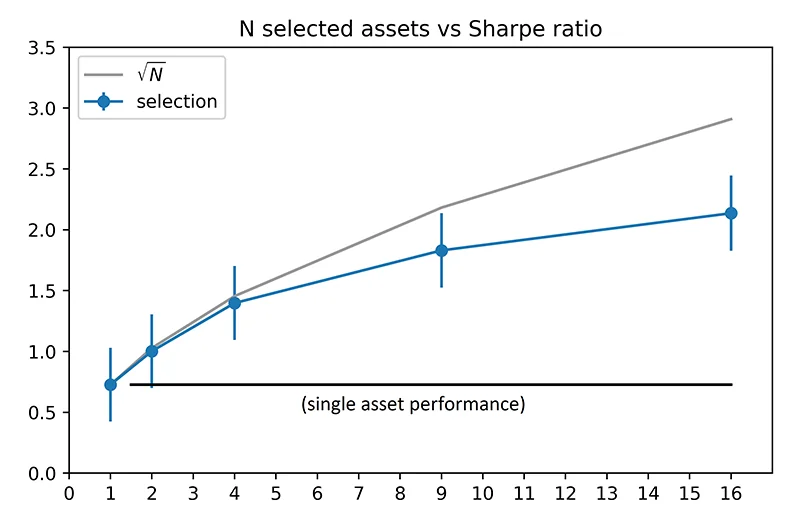
- Each day randomly select specified number (𝑁) of AiLA long/short asset signals and obtain returns with equal risk allocation.
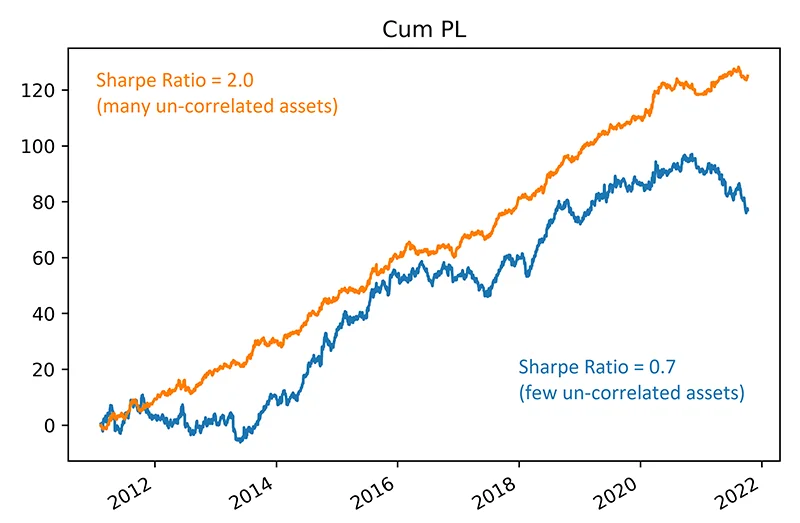
- Sharpe ratio (SR) from all days (2011 to 2021) used as performance metric, and process repeated 100 times to capture average AiLA signal performance.
- Average single asset performance of about SR = 0.7 for signal set used in the study and performance increase with an increasing number of portfolio assets.
- Performance increase due to diversification largely inline with expectation of √𝑁 for un-correlated assets and saturates at larger values of 𝑁 due to correlation between the portfolio assets.
Diversification Limitations
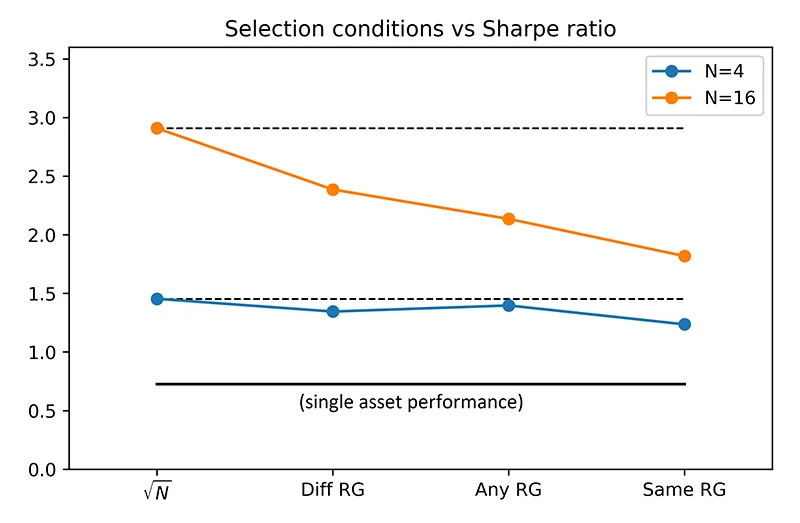
- Impact from asset correlation verified by assigning assets to risk groups (RG), with high (low) asset correlation within (between) groups.
- Results were compared with those using a random selection of assets all from different as well as the same risk group, indicating a degraded diversification benefit as the asset correlation increase.
- The diversification benefit is generally well represented by the number of portfolio assets, however, the effective number of independent assets can be significantly reduced by correlation.
- Similar reduction of effective 𝑁 of assets can be caused by capacity constraints, e.g. if main part of allocation assigned to contracts all belonging to crude oil complex.
(* Further details related to the asset risk groups used can be found in the research subject “controlling correlation”.)
Conclusions
- The AiLA asset signals indicate a diversification benefit potential inline with expectation form the low correlation often observed between commodity markets.
- The unconstrained results indicate a diversification benefit that roughly follow the √𝑁 behavior of un-correlated assets, which saturates at larger 𝑁 values due to asset correlation.
- The diversification benefit therefore largely follow what is to be expected based on the number of portfolio assets.
- However, the effective number of assets can be significantly reduced, compared to the actual number of markets and contracts, in situations where only a smaller number and/or highly correlated assets are able to contribute, e.g. from tight capacity constraints.