AILA S series vs AILAV001
Relationship of Portfolio returns to Vol Index returns
Questions
Questions:
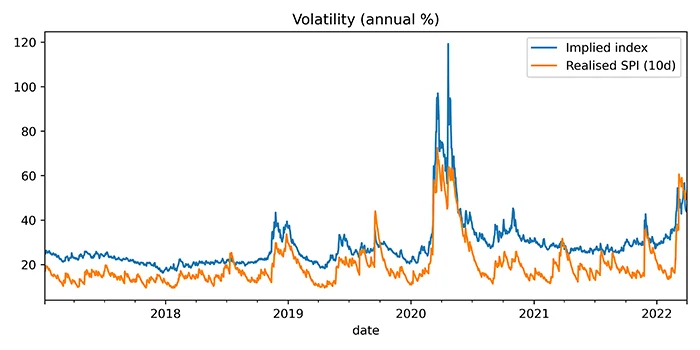
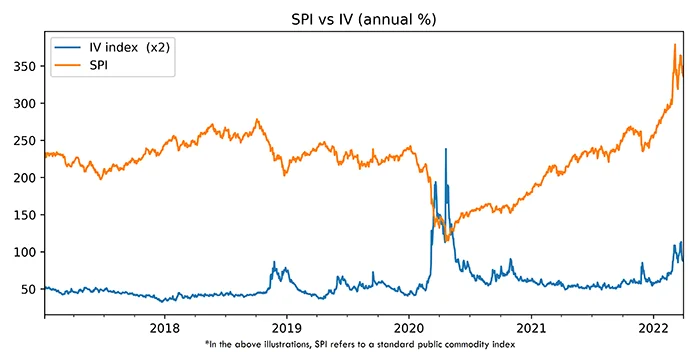
- We use AiLA-V001 which is a vol index created to measure the markets view on volatility.
- The AiLA-V001 index was constructed from liquid options across the most liquid commodities.
- Can we observe any relationships between the AiLA alpha index (AiLA S series) performance and the prevailing volatility conditions reflected by the AiLA-V001?
Approach:
- Given the lack of data sufficiency with one single AiLA index, we pooled many AiLA indices together for the analysis.
- Investigated the expected return historically for the AiLA indices, conditional on different volatility circumstances.
- We use implied volatility and vol index interchangeably as vol index constitutes a basket of implied volatility
Performance vs IV
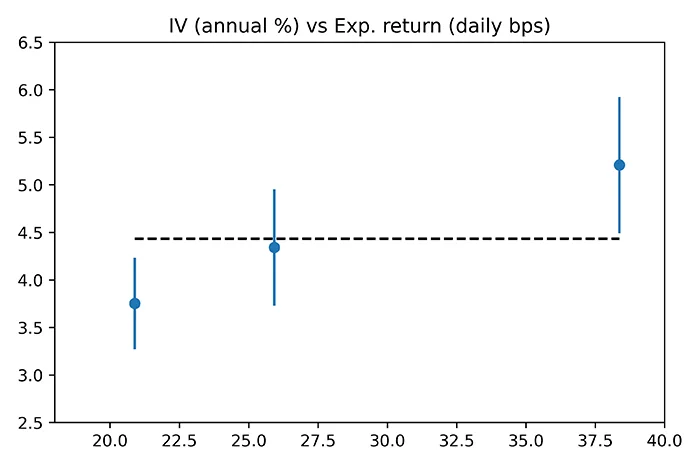
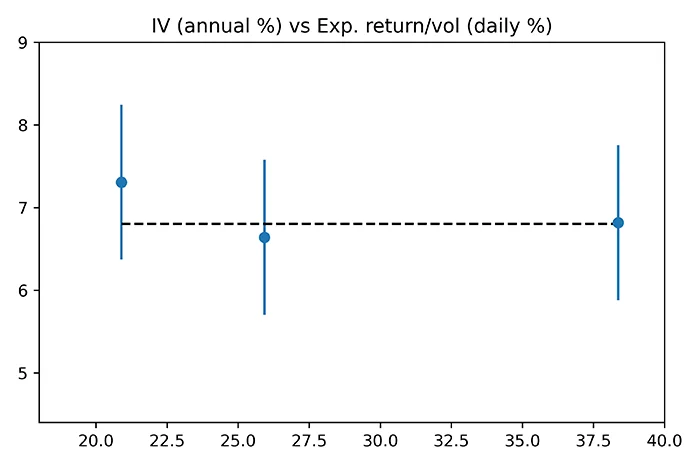
- Split data into three bins based on the prevailing IV index values, i.e. level of volatility.
- Weak indication of expected returns to be larger during periods with higher implied volatility.
- The indication disappear when normalizing the returns to the sample std.dev. of their corresponding bin.
- Therefore, in case of a significant effect, it would primarily be explained by the different size of the returns rather than the ability to predict their sign.
- Indication of a uniform index performance when traded on a risk adjusted basis.
Performance vs ∆ IV
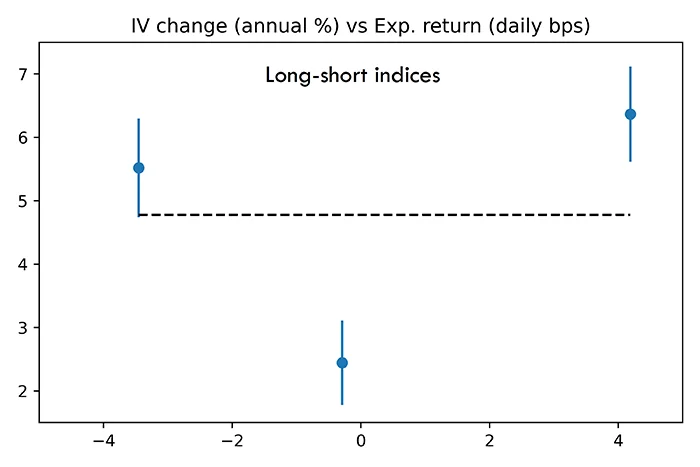
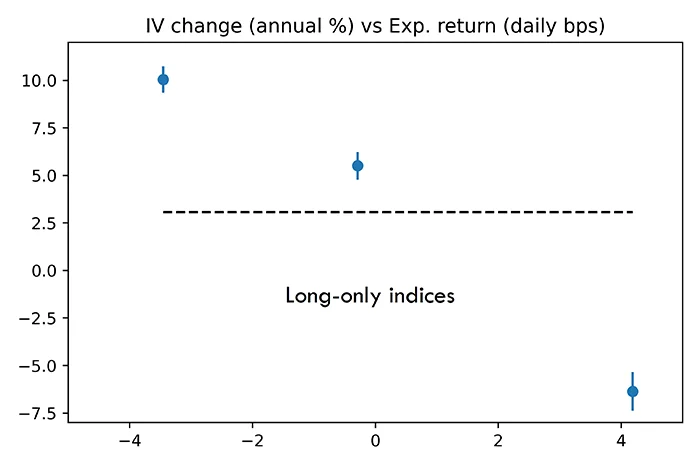
- Split data into three bins based on the prevailing change of IV index values, i.e. decreasing, flat or increasing IV.
- Indicates a different pattern between long-short and long-only AiLA indices.
- The AiLA long-short indices indicates a tendency to perform well in both a decreasing as well as increasing IV environment.
- The AiLA long-only indices indicates a tendency of performing best in a decreasing IV environment and to historically loose money during increasing IV periods.
- The long-only pattern appears intuitively consistent with the typical IV development during a market crash period, e.g. such as the first half of 2020.
Performance vs ∆ IV
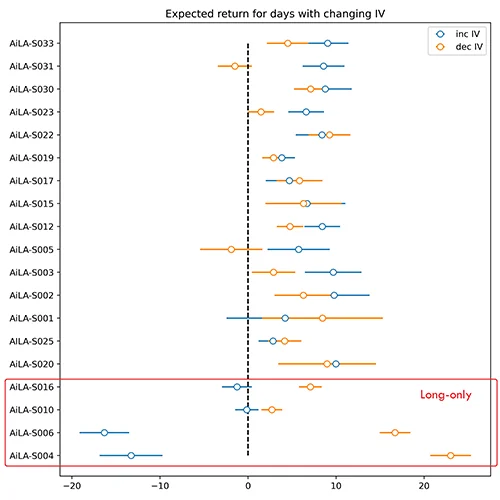
- The performance pattern w.r.t increasing and decreasing IV is generally reflected also when broken down to an individual AiLA index level.
- Here 11 out of the 15 long-short AiLA indices yield an expected return historically larger during increasing IV than decreasing IV.
- All 4 of the long-only AiLA indices yield a smaller expected return during increasing IV than decreasing IV, with negative increasing IV values.
- It should, however, be noted that the limited data set and corresponding large statistical errors generally makes it difficult to draw strong general conclusions.
Conclusions
- An implied volatility index (AiLA-V001) was used to measure the markets view on volatility, and was used in a study of potential relationships with the performance of the AiLA alpha indices (AiLA S series).
- An indication of a slight performance difference w.r.t the level of IV was obtained, however, the potential effect was found consistent with the difference in size of the returns.
- A different performance pattern was, however, observed between the AiLA long-short vs long-only indices.
- For the long-short indices high expected returns were obtained both during increasing as well as decreasing IV, whereas for the long-only indices decreasing IV typically was associated with significantly higher expected returns than increasing IV.
- These result are intended as an initial overview regarding relationships between the AiLA alpha and IV indices, with further research work expected to follow on the topic of volatility.